A Thought
“Your assumptions are your windows on the world. Scrub them off every once in a while, or the light won't come in.” ― Isaac Asimov.
Our ability to objectively evaluate the assumptions we make is a great skill and a challenging pursuit. Be it solving a problem, making a decision or deriving insights from information we are presented with, we tend to make assumptions at some level. The assumptions we make have the ultimate power to make our solutions, insights and decisions valid, useful and relevant. Conversely, the assumptions can also make our solutions invalid, insights useless and decisions profoundly wrong. Let's use the following real life story to illustrate the perils of assumptions.
During World War II, the US military realised it was losing a lot of aircrafts and they could armor these aircrafts better to increase the survival rate. So, here’s the challenge. The US military do not want their aircrafts to get shot down by enemy fighters, so they wanted to put armor on the aircrafts. But armor makes the aircrafts heavier, and heavier aircrafts are less maneuverable and use more fuel. Armoring the aircrafts too much is a problem; armoring the aircrafts too little is a problem. So, what should be the optimum level of armor, and where should they be placed? A key decision that would lead to developing a solution to save millions of dollars in lost aircrafts and invaluable human lives.
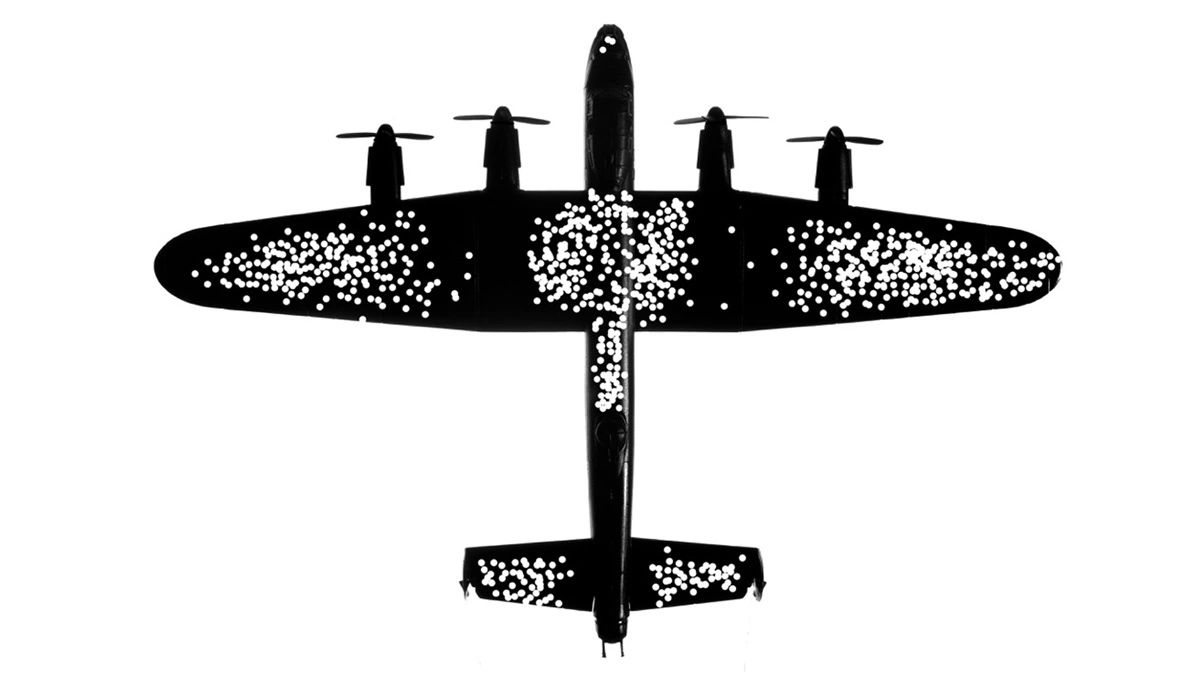
The military came to the Statistical Research Group (SRG) with some data they thought might be useful (SRG was one of the premier statistical research centres in the US at the time) to solve this challenge. When the planes came back from air strikes, they were covered in bullet holes. But, the damage was not uniformly distributed across the aircraft. There were more bullet holes in the fuselage, not so many in the engines. The summarised data distribution looked something like the following.
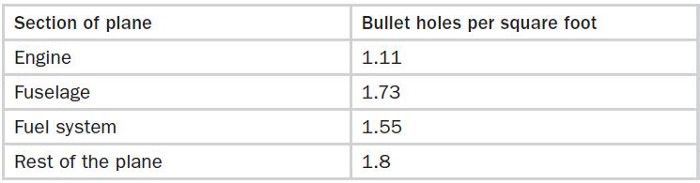
The military officers saw a great opportunity for improving aircraft survival rates. The aircrafts can get the same protection with less armor if the protective armor is concentrated, where the planes are getting hit the most. But exactly how much more armor belonged on those parts of the plane was the question they wanted SRG to assist with.
SRG appointed Abraham Wald for the task given his knowledge in statistics, and most importantly, being able to see hidden patterns. After analysing the data, Abraham Wald's response to the military was something that no one had expected. Wald asserted, the armor doesn’t go where the bullet holes are. The armor goes where the bullet holes aren’t: on the engines.
Most planes getting shot in the engines and mid-body were being destroyed from the damage and weren’t making it back to be analysed.
The US military officials thought that they had discovered where its planes were suffering the most damage. Instead, what they had discovered was, where its planes could take damage without being destroyed.
A Lesson
In the above example case, the officers were making an assumption unwittingly: that the planes that came back were a random sample of all the planes that went to war. If that were true, then we can look at the bullet distribution pattern of the returned planes to work out where the armor should go. Simple enough. But, the problem was, this assumption was utterly wrong. The planes that came back was not a random sample of all the planes that went to war. What they had was a random sample of planes from the planes that returned home; not all the planes.
Abraham Wald’s insight was simply to recognise the assumption made by the officers and ask: where are the missing bullet holes? The missing bullet holes were on the missing planes that was not a part of the sample data set. The reason planes were coming back with fewer hits to the engine is that most planes that got hit in the engine weren’t coming back. This indeed is the power of our underlying assumptions in action when making decisions, building solutions and deriving insights.
The blinding nature of assumptions is that it doesn't require us to actively think about what could be wrong or prove if the assumption is correct. We make the assumption as a foundation element when we want to move a solution forward or when building a model to answer a question. Contrast this to a hypothesis. By definition, if it's a hypothesis, we must prove if we accept or reject that hypothesis.
The definition of an assumption is an idea that is formed without evidence. An example of an assumption is that there will be food at a party. Something taken for granted or accepted as true without proof.
A hypothesis on the other hand is a tentative statement that requires to be validated before acceptance. It is a specific, testable prediction about what you expect to happen. For example, a study designed to look at the relationship between sleep deprivation and test performance might have a hypothesis that states, "This study is designed to assess the hypothesis that sleep-deprived people will perform worse on a test than individuals who are not sleep-deprived". The 'assumption version' of the same example would be to simply assert and accept that sleep-deprived people will perform worse on a test than individuals who are not sleep-deprived. No evidence is required.
As Chris Voss, the famous FBI negotiator - turned businessman said, 'assumptions blind, hypothesis guide'. This quote applies to both professional and personal life.
A Call To Action
So, what assumptions are we making in our professional and personal life when making decisions? Can we instead turn these assumptions into hypothesis?
It is important to recognise that not everything can be turned into a hypothesis. Though it makes theoretical sense, in practical terms, we may not have the luxury of going through a process of hypothesis testing or validating all our underlying assumptions.
So, let's always keep in mind that regardless of how much good data we are presented with, or how convincing narratives we are told, the decisions, solutions and insights we derive from those elements will only be as good as the assumptions we made on them. As Isaac Asimov said, “your assumptions are your windows on the world. Scrub them off every once in a while, or the light won't come in.”
Credit: How Not To Be Wrong by Jordan Ellenberg | Chris Voss
Kushan Kahadugoda
Strategist, founder and author exploring technology, leadership and human potential.
About Kushan