
A Thought
When faced with uncertainty, how should one react? Should we go big and double-down, or hedge our position, or just do nothing and wait and see what happens? We naturally tend to see situations in one of two ways:
- events are certain and can therefore be managed by planning, processes, and reliable budgets; or
- they are uncertain, and we cannot manage them well at all.
Lack of certainty/ presence of uncertainty (about the future) is the very reason why we need strategies in our lives, business and just about any future oriented endeavor. What research shows us is, rather than looking for certainty, embracing probabilistic thinking would yield superior long-term results.
Remember, as Yogi Berra (and, before him, physicist Niels Bohr) said, "predictions are difficult, especially about the future”.
A Lesson
Imagine you are at a billiard table. You are blindfolded and your assistant randomly rolls a ball across the table. They take note of where it stops rolling. Your job is to figure out where the ball is. All you can really do at this point is make a random guess. Now imagine that you ask your assistant to drop some more balls on the table and tell you whether they stop to the left or right of the first ball. If all the balls stop to the right, what can you say about the position of the first ball? If more balls are thrown, how does this improve your knowledge of the position of the first ball? In fact, throw after throw, you should be able to narrow down the area in which the first ball probably lies. This is an example of probabilistic thinking.
Data can be imperfect, incomplete, or uncertain. There is often more than one explanation for why things happened the way they did; and by examining those alternative explanations using probability, we can gain a better understanding of what is really going on.
However, thinking probabilistically takes some getting used to. We humans naturally think deterministically. We generally believe that something is true or false. Either you like someone or you don’t. There is rarely, for example, a situation when one can/ will say that there is a 72% probability that person X is their friend. Our instinct for determinism may well have been an evolutionary innovation. To survive, we had to make snap judgments about the world and our response to it - for example, when a tiger was approaching us, there was really not a lot of time to consider whether its approaching to play with us or eat us.
So, how does this relate to strategy? Uncertainty is not only everywhere in and around a strategy - it is the very reason we need strategy. Without uncertainty, we would just need a plan to go from A to B.
A Call To Action
Strategy requires confronting uncertainty head-on by embracing the notion of probability. Developing a probabilistic approach allows us to be better prepared for the uncertainties and complexities. Even when events are determined by an infinitely complex set of factors, probabilistic thinking can help us identify the most likely outcomes and the best decisions to make.
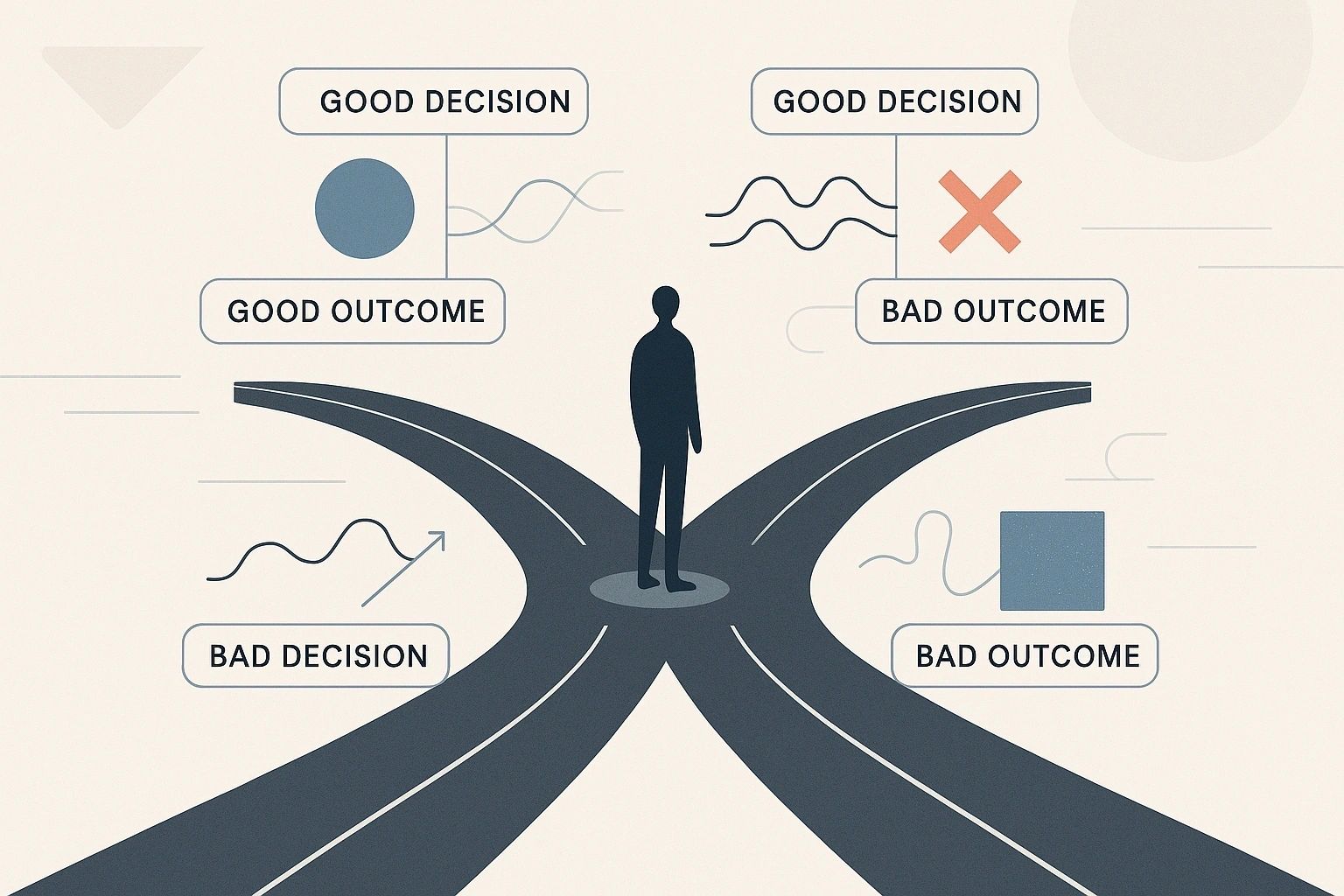
So how do we create a strategy that embraces probabilities? In any game, as in business or life, our goal is to give ourselves the best possible odds of achieving success (however we define it). For example, if 5 companies, each have an 80 percent chance of succeeding, that still means that one will usually fail. If 5 companies, each have a 20 percent chance of success, one of the 5 is still likely to win. Clearly, the superior strategy is the one with an 80 percent chance of success, and this is the one that should be given the credit, no matter whether we win or lose.
Based on the concepts of uncertainty, probability and strategy, how can you make your next future decision in a way that it stack the odds in your favor?
Credit: Book: Strategy Beyond the Hockey Stick | Develop a “Probabilistic” Approach to Managing Uncertainty (HBR) | Mackenzie: How to confront uncertainty in your strategy

Kushan Kahadugoda
Strategist, founder and author exploring technology, leadership and human potential.
About Kushan