What
Infonomics is the emerging discipline of managing and accounting for information with the same or similar rigor and formality as other traditional assets and liabilities (such as financial, physical and intangible assets). Infonomics describes how information itself meets all the criteria of a formal company asset. Information is not yet recognised by GAAP or IFRS (or other accounting standards) as a formal asset that can be included on the balance sheet.
Why
Though information/ data assets are not recognised as a 'real' asset from an accounting stand point, it is increasingly incumbent on organisations to adopt the view that information is in fact a real asset. The reasons for this are multi-faceted.
In the very near future, businesses will compete based on their data analytics prowess. This will make data the most valuable raw strategic asset for most businesses. This in fact has become the reality for many technology giants in the world - be it Google, Facebook, Amazon, Alibaba, Twitter etc. The value of these companies are signified because of the vast array and volume of data they hold on many entities and subjects of the world. When businesses become more data centric and data rich, and more investments keep pouring into data projects, it is paramount that we have a way to meaningfully and objectively value information assets these projects will produce (or service).
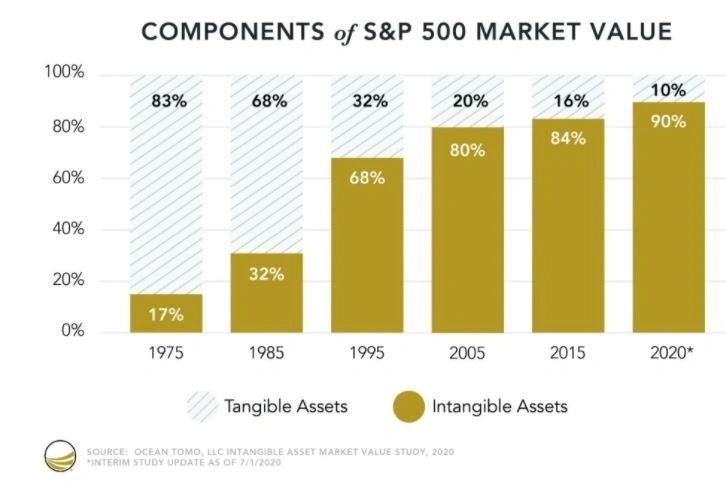
According to research done by investment firm Ocean Tomo, in the seventies, tangible assets (i.e. buildings, machinery, inventory etc) made up over 80% of the US stock market’s value. Thirty years later, in the 2000s, tangible assets only account for 20% of the S&P 500’s value. Intangibles such as brand, knowledge and information are the key sources of corporate value in the modern age.
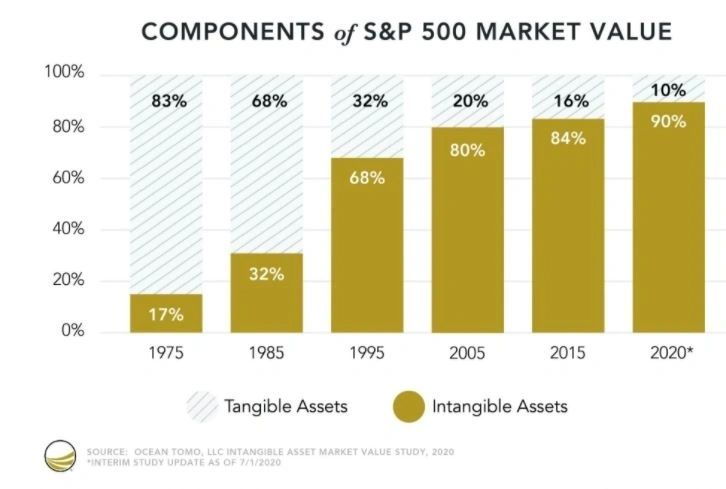
The graph above highlights the substantial increase in the ratio between tangible and intangible asset value in S&P 500 companies since 1975.
Between 1995 and 2015, the share of intangible asset market value increased from 68% to 84%. This trend holds for the S&P Europe 350 index as well, but, to a lesser extent, with an increase from 71% in 2015 to 74% in 2020.
Though there is no specific break-down of the intangible asset component into brand, knowledge, information etc, if we were to devise an agreeable information asset valuation model, the value of information could in fact be the most valuable out of all intangible asset categories.
Another key reason for embarking on a journey towards information asset valuation is to thoroughly explore the expenditure on Information Technology (IT). This expenditure category has grown significantly during the last 20 years. However, much of the emphasis has been on investing in the ‘T’ part of IT – i.e. the hardware and software that enables the acquisition, storage and processing of data. The investments into the 'I' part of IT has not kept pace with the former. As Professor Chris Higson of London Business School put it, "this (imbalanced investment between I and T of IT) in turn has accelerated the ‘drowning in data but thirsting for insight’ syndrome that frustrates many business users".
Even if we utilise a simple intrinsic information valuation model for corporate information assets, the return on that effort could be significant. With such a model, though rudimentary, we will have a way to assess what information assets carry the highest value and make investment decisions based on that to maximise ROI.
NB: Another key point to consider and keep in front of mind when it comes to information and data is that not all of them will be 'assets'. Certain information and data sets will fall into the category of a liability. Therefore, it is prudent that we don't apply blanket rules, such as all information and data are assets.
How
The starting point for an information valuation process will be the completion of an information audit and creation of an Information Asset Register (IAR). The IAR provides the basis for valuation of information assets and it is essential if the organisation is to transform and optimise its information assets.
In terms of the methodologies for information valuation processes, the following provide robust blueprints, depending on the applications and outcomes required.
- Forrester Total Economic Impact™ (TEI) methodology
- Gartner Applied Infonomics methodology (for more details refer to the book Infonomics)
- The National Archives – ‘Information Management Value Model’
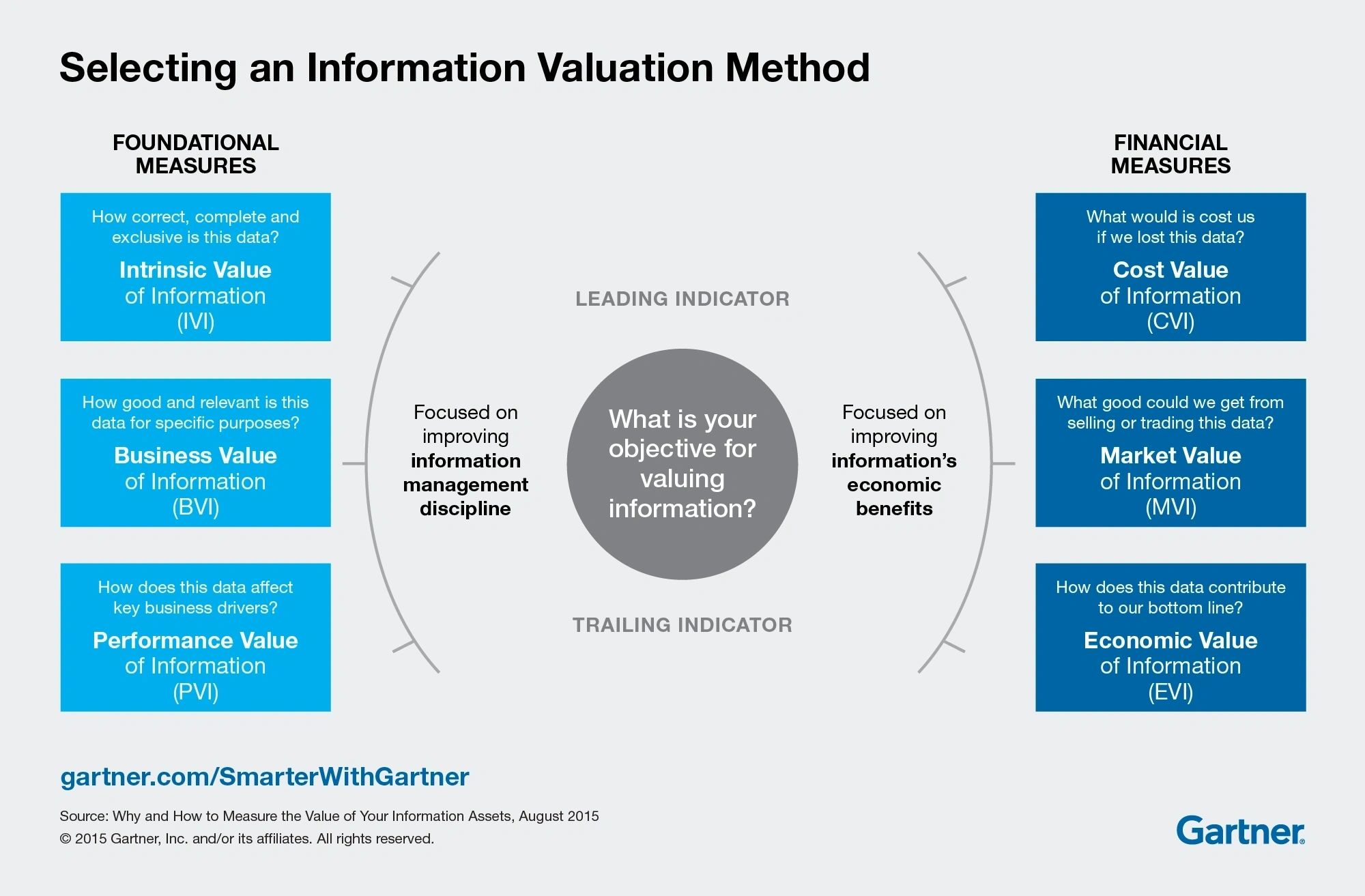
The Gartner's Information Valuation methodology in particular provides an easy to understand and executable framework for valuing information.
This framework provides a multi-level valuation model based on the maturity and appetite of an organisation. At a base level, we can start with the Intrinsic Value of Information (IVI) model. The other end of the spectrum of complexity is the Economic Value of Information (EVI) model.
For more details of this methodology, I would recommend the book Infonomics.
NB: It is vitally important to clearly document and agree on the objective(s) for valuing corporate information with appropriate executive leaders of the organisation. Otherwise, the information valuation journey will either end before it gets to any meaningful outcome, or it will be just a theoretical exercise.
Credit: Gartner Inc | Ocean Tomo | Valuing Information as an Asset by Chris Higson & Dave Waltho | Infonomics book Douglas Laney

Kushan Kahadugoda
Strategist, founder and author exploring technology, leadership and human potential.
About Kushan